
Spain Parador Package – “Castles of Spain”
Spanish castle magic!
No hotel experience is quite like staying in
a real castle. You can walk in the very footsteps of
knights and kings – sleep where they slept, and perhaps even dream the
dreams they dreamed!This is a very special kind of travel experience, and
for those who love the passionate and romantic history of this land – it
really can be the trip of a lifetime.(See
info on all 14 of the Parador’s castle hotels here)
Alarcon:History has it that around 1200
years ago, a prince of the Visigoths discovered this site while out hunting.
A rugged and rocky hill nearly surrounded by water – he thought it a perfect
place to build a fortress. His father, King Alaric, did build a castle
here – and it still bears his name.Walls set with turrets surround
the castle and the small town of Alarcon. One of these towers (called
a coracha) is right down on the river Jucar. It was from under this
one that the townspeople could obtain water during a siege.The castle was controlled by the Moors for hundreds of years. In
1184, after a long unsuccessful siege, a brave knight climbed the walls one
night by using two daggers to wedge between the slits in the stone. He got
over and opened the doors from within allowing King Alfonso VIII and his
forces in to recapture the castle for the Christian reconquest.The castle
Parador of Alarcon
is the kind castle lovers dream of. It looks and feels like a castle,
and one can literally sense the history of the place as a palpable presence.


Castle side trip: Be sure and drive over
to Belmonte to see the wonderful old abandoned,
yet well-preserved 15th century castle there (image below). You can
climb up into the towers and walk around inside the grounds. It has a
rare and beautiful triangular patio. If you go on a weekday – you’ll likely
have it all to yourself.
Siguenza:
This is a massive structure.
The Romans originally had a settlement here on this hill. The Moors
later built a fortress on the site of that Roman settlement. Then in
1123, construction of the castle you see today was begun by bishop Benardo
de Agen – to become his own fortified residence.Each new Bishop maintained their residence here and extended the
structure. Gradually it became more of a palace and less of a fort.
It was substantially remodeled in the 14th century and again in the 15th
century.The Parador Siguenza
has many fine rooms – and contains interesting and beautiful features both
in its public areas and private rooms. The two twin towers, the Torres Gemelas,
were built in the 16th century. There is a throne room with two amazing
French styled fireplaces. Wooden beamed ceilings are everywhere, and
the dining room is in a huge stone walled room with a row of gigantic
arches.
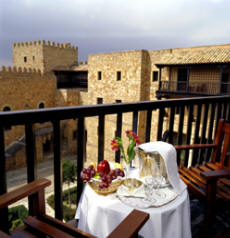

Castle side trip: While you are staying
at Siguenza, or on your drive to Oropesa, you can make a pleasant stop and
investigate the castle ruins at Torija (image
below).


Oropesa:
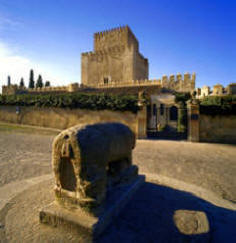
There are two castles
here – separated by an immense wall that is crowned by a magnificent
machicolated parapet and an awesome tower (seen in the image at left).The "Old Castle" was built in the 14th century as a sort of sentry
that guarded the main road from Extremadura to the Meseta. Much of it
was torn down to provide stones for the Mudejar-styled "New Castle" in the
15th century.At one time the castle complex was controlled by Don Francisco de
Toledo – Duke of Alba, and the Viceroy of Peru (he founded the city of
Cochabamba in Peru). He and later lords added an extended set of
palatial rooms and quarters to create finally what you see today.The Parador
Oropesa
is majestic in every sense of the word. It is spacious, elegant, and
imposing. Climb and walk along the walls – you’ll be rewarded with
wonderful views out over the Gredos valley. Dining here will be a special
treat as this Parador serves as a chef’s school for the other Paradors and
the cuisine is extraordinary.


Interesting excursion: For a really
neat half-day trip, drive down to Guadalupe
(for a description, click here –
Guadalupe)
Jarandilla De La Vera:
The Knights Templar had a fortification on this spot before the
current castle’s construction was begun in the late 14th century.This was the favorite spot of
Charles V – King of Spain, Holy Roman Emperor – and the most powerful man in
the world during his age. He gave up all his power and relinquished his
throne and titles to spend his last years here in Jarandilla (and the nearby
Yuste Monastery) working in its
gardens and contemplating.Jarandilla is located in an area much blessed by Nature. It was – and
is – considered almost a kind of paradise. There are many waterfalls
in the area, and gardens and orchards abound.The Parador Jarandilla De La Vera
is much more palace-like than the other castles at which you will stay.
It is small and compact with four towers sitting at each corner of its walls.
It’s really a fortified Renaissance Palace built in an Italian style – an
oasis of tranquility and natural beauty.


Interesting excursion: Either on your
way to Ciudad Rodrigo (below), or on your way back – be sure and stop in
La Alberca. It will be an incredible step back
into history. The village is as if still living in medieval times. The whole
town has been declared a national historic monument.
Ciudad Rodrigo:
It fell to the castle at Ciudad Rodrigo to
defend Spain against both the Moors and also to watch over and defend the border
with Portugal. The castle with its magnificent tower, Torre del Homenaje, is
set on a cliff overlooking the river Agueda and the plains below.This bastion was built by Enrique de Trastamara in the 14th century
after he had killed his stepbrother – the legitimate king, Pedro The Cruel –
and usurped his throne.In this town, perhaps the most critical part of Spain’s history played
out. The Visigothic King Rodrigo raped the daughter of the governor of Ceuta
(located in North Africa – in modern day Morocco). The governor was so
enraged that he allowed the Moors to disembark for Spain from his port and
thus began the Moorish conquest and occupation that lasted for centuries. Rodrigo was said to have later entombed himself alive with a poisonous
snake to die in terrible pain trying to atone for his sin.The fine Parador Ciudad Rodrigo
overlooks the town and is the perfect base from which to take walking
excursions. The old walled city is great for just wandering around
with no particular itinerary. Don’t miss the beautiful cathedral.
Construction on this cathedral was begun in the 12th century. Its design is part
Romanesque and part Gothic.

Interesting excursion: Try to visit
the walled city of Avila on your drive back to Madrid (click to see
description – Avila)
Madrid:
Madrid is hands-down winner of the title, "Europe’s Liveliest City."
Madrileños don’t really get their day into high gear until after
dinnertime – and dinner usually starts around 10:00 p.m.! Then
they flood their beloved city’s streets and "pasear" (stroll around) or
"tapear" (hop from tapa bar to tapa bar) until dawn.Some speak of Madrid as being drab, but how far from the truth that
is! Granted it suffers, as do many of the world’s major cities,
from urban sprawl – but once you get past the concrete jungle outskirts,
you’ll discover a city that provides
endless surprises and discoveries.There are many pockets of very old buildings that contain odd
assortments of shops, tiendas and bars. You’ll happen upon
eighteenth-century Bourbon squares, pleasant plazas and quaint
restaurants at every other turn.
Must Sees: The Prado
museum, the Royal Palace – the
Reina Sofía and
Thyssen-Bornemisza galleries,
the Plaza Mayor, the Retiro Park,
Gran Via – and
the list could go on and on.But really – the thing that makes Madrid so special are the street
scenes, the people and the energy that makes this the night-time,
high-energy capital of Europe.You’ll stay in one of Madrid’s fine hotels. We will
book you into 3 or 4 star accommodations that will be conveniently located
for easy exploration of Madrid "must see" sites like; the
Plaza Mayor, the Puerta del Sol, the picturesque
Rastro, Gran
Vía with its many fashion centers and high-end stores, and Madrid’s
trio of world famous museums; the Prado, Thyssen and Reina
Sofía (these all free entry to you!)


*
Package – 10 nights – includes:– All Paradors and hotels
– Car rental for all days except when
in Madrid –Contact us for current prices . . .
We will take care of
arranging every aspect of this special journey for you. The Castles of Spain travel package will
provide you a "dream-come-true" type vacation like very few other
travelers will ever
experience.Contact us right away
and begin planning your
dream vacation to the "Castles of Spain."
|
* Visit our hotel pages * Parador Hotels |
Be
sure and subscribe to our "Parador Watch" newsletter here


(Spain Parador information provided courtesy of SpainParador.com)